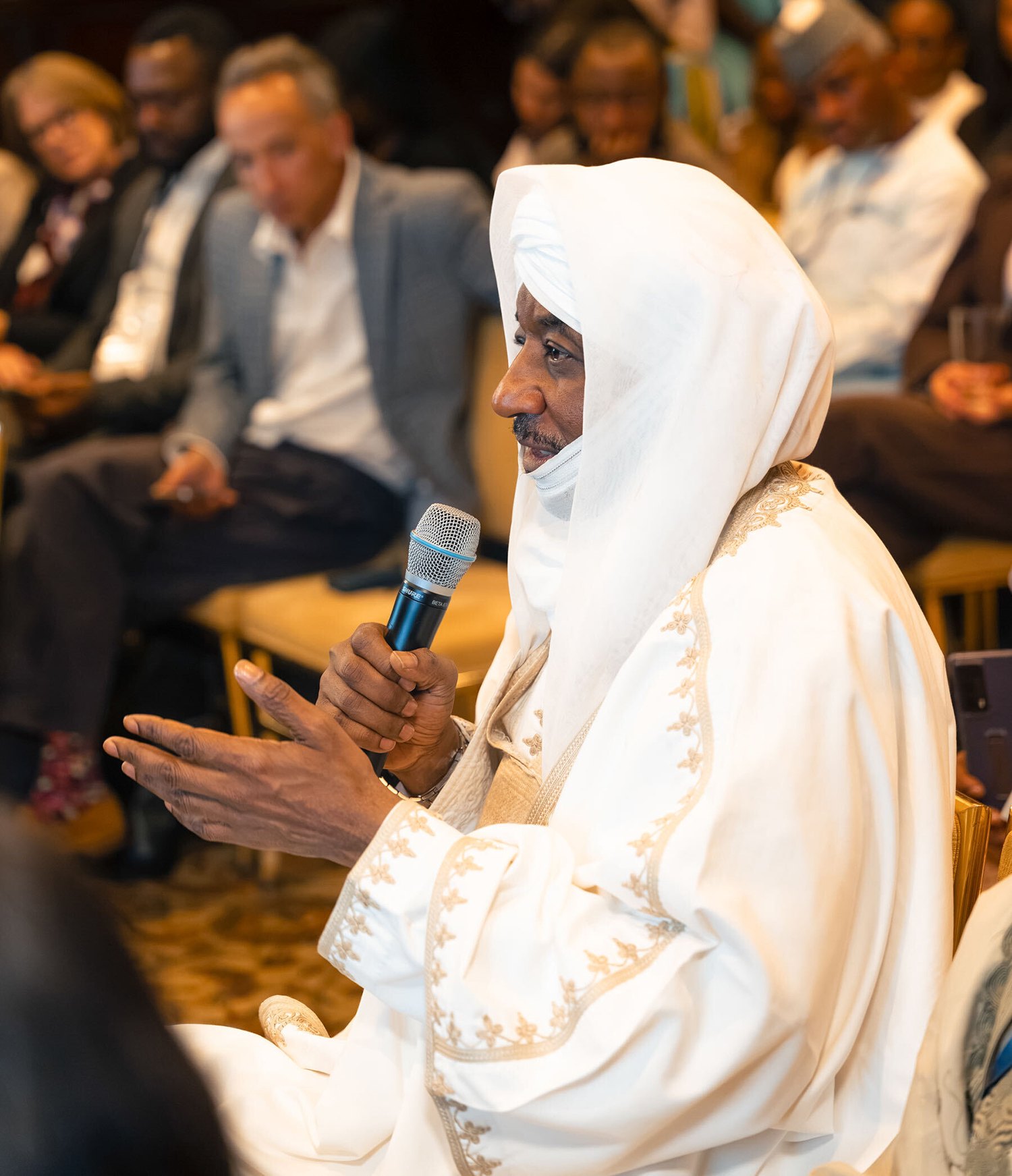
For more than a decade, financial inclusion has been measured largely by accounts opened and payments completed. Bridgforte’s work asks whether people trust the financial system enough to depend on it. At Bridgforte Dialogues @ UNGA 81, HRH Muhammadu Sanusi II, Emir of Kano, took the question further. As Governor of the Central Bank of Nigeria, he had launched the country’s first National Financial Inclusion Strategy and the cashless policy that set off a decade of payments innovation. He asked what that progress has enabled households and businesses to do.
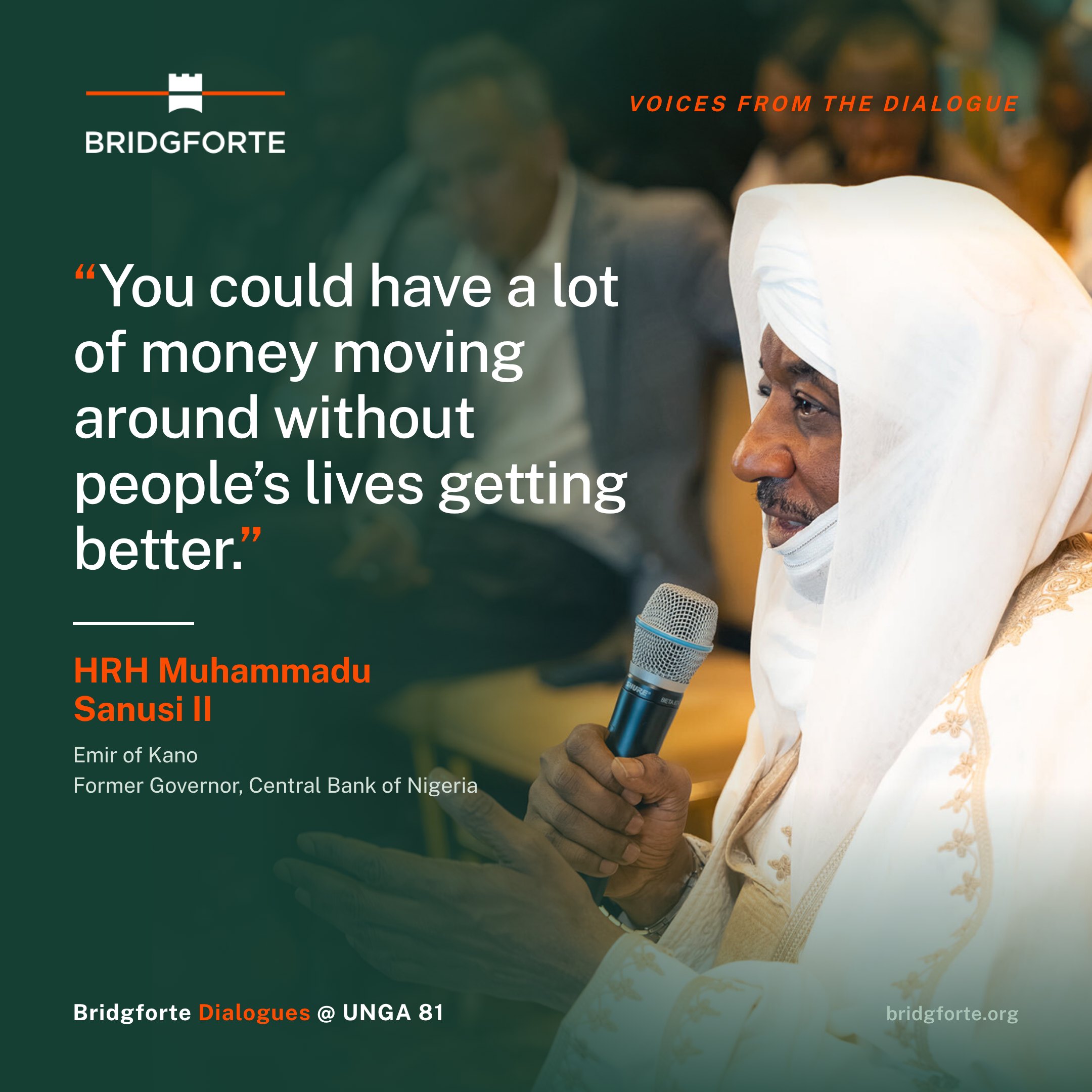
“You could have a lot of money moving around without people’s lives getting better.”
HRH Muhammadu Sanusi II — Emir of Kano and former Governor of the Central Bank of Nigeria
His challenge was to distinguish the movement of money from the economic opportunities it supports. Higher transaction values demonstrate activity; they do not, on their own, establish whether households are becoming more resilient or businesses more productive.
Sanusi also cautioned against treating lower poverty rates as evidence of financial security. National financial-health data illustrate the wider vulnerability he described.
In 2023, 78 per cent of Nigerian adults could not raise ₦75,000 within a week in an emergency, and only 16 per cent were financially healthy, down from 28 per cent in 2020. Financial inclusion, in his words, should become “a basis for economic inclusion”: credit that supports productive activity, insurance that provides protection and pensions that help people prepare for later life.
A completed payment shows that a service worked. It does not show whether a household can absorb an income shock or a business can invest.
Connecting finance to the wider economy
Sanusi illustrated the point with Kano, once known for its groundnut pyramids. The city is now home to a manufacturer of ready-to-use therapeutic food that relies on imported groundnuts, because locally processed supplies do not yet consistently meet the required quality standards. His diagnosis was practical: nobody had helped local farmers learn to dry their groundnuts to the standard needed to supply it.
The example exposes a gap that greater payment activity alone cannot close. Connecting farmers to a buyer requires production capabilities and a dependable route to market, alongside appropriate finance. Sanusi was explicit that part of this work rests with government and structural policy.
For financial institutions and policymakers, the implication is to examine the constraints surrounding a financial service. More lending cannot, by itself, resolve a production or market-access problem. Product design and public policy need to respond to the conditions under which people can use finance productively and safely.
Others at the Dialogue took up his challenge. Tamara Cook of the Office of the UN Secretary-General’s Special Advocate for Financial Health connected it to financial health, which asks whether people’s lives actually improve. She asked the room to picture a motorcycle taxi driver whose insurance claim takes a month to pay. With no income in the meantime, the lesson he draws is to stop buying insurance and borrow next time. A failure of trust after purchase becomes a retreat from the very products that build resilience.
Olugbenga Agboola, CEO and Co-Founder of Flutterwave, described a related shift from processing payments towards meeting customers’ wider financial needs. He pointed to lending and investment products and ambitions to extend into insurance and pensions. His contribution raised a further question: how can providers turn the relationships established through payments into services that help customers build security over time?
Where Trust Architecture meets opportunity
Bridgforte’s report, Trust Architecture in Platform-Led Finance, examines whether people can depend on the financial system. Sanusi’s challenge asks what that dependable participation should make possible.
The two questions meet wherever people make long-term commitments. Entrusting savings to an institution, buying insurance or committing to a pension requires confidence that promises will be honoured. Three pillars of Bridgforte’s framework are particularly relevant: Institutional Accountability identifies who is responsible; Ecosystem Coordination addresses how providers work together; and Cultural Confidence examines how experience shapes people’s willingness to rely on the system. Cook’s example shows how delayed recourse can undermine that confidence precisely when protection is needed.
Trustworthy financial services can support such decisions, but cannot guarantee better livelihoods. Employment, incomes, productive capabilities and public policy also shape outcomes. Keeping that distinction clear helps identify where financial institutions can act and where wider cooperation is needed.
Measuring what participation makes possible
The next phase of research therefore needs three layers of evidence. Participation measures establish who can access and use services. Trust measures examine whether people feel able to depend on the system, including when difficulties arise. Financial health and economic outcomes show whether people are becoming more resilient and better able to pursue opportunities. No layer is proof of another: frequent use may reflect necessity or limited alternatives, and confidence may coexist with financial vulnerability.
This question also matters for Nigeria’s Payments System Vision 2028, which identifies trust as one of its guiding principles. Measuring it requires evidence of how people experience the system alongside information about institutional performance. For Bridgforte, trust is architecture: it is built by design, and its assessment must connect the reliability of institutions with the confidence of the people who depend on them.
Bridgforte’s Lagos Executive Table offers an initial indication of where to look. Participants ranked service reliability and dispute resolution ahead of fraud among their concerns. These practitioner perspectives help identify questions for consumer research: what happens to confidence after a failed transaction, how does the response affect subsequent behaviour, and what enables trust to recover?
Recommendation 8 of Bridgforte’s report calls on development partners to fund a longitudinal Trust Barometer: a consumer trust survey of Nigeria’s financial system, comparable over time and across frontier markets. Sanusi’s intervention adds a question for that research: how does confidence relate to the financial decisions people make and the outcomes they experience? Tracking those relationships over time would help establish whether, and under what conditions, more dependable services contribute to greater resilience and economic opportunity.
Beyond trust: resilience and economic opportunity
“Beyond trust,” Sanusi said, “it’s also about hope.” He described inclusion as one step on a path to a better life and a way out of poverty. In practice, that means credit that finances production, insurance that pays when it is needed, pensions and savings that build a buffer against shocks, and links between finance and the real economy, such as the farmers who could supply Kano’s manufacturer.
At a convening on trust, the phrase was pointed. Trust helps sustain people’s willingness to rely on financial services. It is not, on its own, evidence that inclusion has worked. For the financial ecosystem, that sets a demanding standard: progress should be judged by the reliability people can count on and the opportunities that participation helps them pursue.
Aishah N. Ahmad, CFA, OFR, is Founder of the Bridgforte Centre for Global Impact and former Deputy Governor for Financial System Stability at the Central Bank of Nigeria.
Sources
- Bridgforte Centre for Global Impact (2026). Trust Architecture in Platform-Led Finance: Structural Governance Imperatives for Nigeria’s Digital Financial Ecosystem.
- Central Bank of Nigeria, Payments System Vision 2028
- Emergency funds and financial health, 2023: EFInA, Beyond Access: Why Financial Health Must Be Nigeria’s Next Inclusion Goal, 2025
- Imported groundnuts for RUTF production in Kano: The Sun, 18 June 2026
This article forms part of Voices from the Dialogue, Bridgforte’s series developing the policy and research questions emerging from its convenings.
Explore the framework and recommendations in Trust Architecture in Platform-Led Finance, and contribute to the next phase of research through dialogues@bridgforte.org.
Read the Trust Architecture report