
Embargoed until launch
Trust Architecture in Platform-Led Finance
The full report and PDF download become available when the report launches at the Trust Architecture Dialogue.
Tuesday, 28 July 2026 · 5:00 PM WAT/BST · 12:00 PM EDT

Nigeria’s digital finance snapshot
A system that has expanded rapidly in scale and in complexity
Active bank accounts as of March 2025, with 67.8 million unique BVN holders by end-2025 (NIBSS)
Electronic payment transactions in 2024 - a 78% year-on-year increase, crossing the quadrillion-naira threshold for the first time (NIBSS)
Real-time payment transactions via NIP - the first African system rated ‘mature inclusivity’ by AfricaNenda (2025)
Mobile money transactions in 2024, across 3.9 billion transactions and 17 licensed operators (NIBSS)
Digital payment fraud losses in 2025 - more than double 2021 levels on the underlying trend (NIBSS Fraud Report, 2026)
Single fraud incident driving the 2024 spike of ₦52.26bn - exposing systemic vulnerability to catastrophic single-point failure
Key findings
Where trust breaks down, and why it is a design problem
Drawn from structured polling and facilitated discussion among thirty senior leaders across Nigeria’s financial ecosystem, convened in Lagos in February 2026.
Trust failures are operational before they are technological
Service reliability and dispute resolution are the primary drivers of confidence erosion - far outweighing fraud, data privacy, and AI concerns. Systems are judged by how they perform when they fail.
Identity infrastructure is the structural root of trust
Fragmented identity systems undermine fraud prevention, consumer recourse, and accountability. Identity must be treated as shared infrastructure - a public good - not a compliance function.
Real-time payments carry an unresolved design trade-off
Speed accelerates inclusion but amplifies fraud exposure when safeguards are not embedded in system architecture. The fraud problem is less about volume than consequence.
AI is a governance challenge, not a technology challenge
The principal risks lie in data misuse, lack of explainability, and embedded bias - not the technology itself. A governance window exists, and it should be used.
Institutions collaborate less effectively than fraud networks
A structural failure, not a moral one: institutional mistrust and competitive incentives ranked above legal, regulatory, and technological barriers to collaboration.
Regulatory models are misaligned with platform-led systems
Risk now arises from interactions between actors, not any single institution's behaviour. Supervision must evolve from controlling institutions to governing system dynamics.
Average trust-resilience score participants gave Nigeria’s financial ecosystem. In a system that depends on confidence, a midpoint assessment from the leaders closest to its performance is itself a finding.
The question for Nigeria’s financial ecosystem is no longer how to move money. It is how to build the confidence that makes people willing to let go of it.
Analytical framework
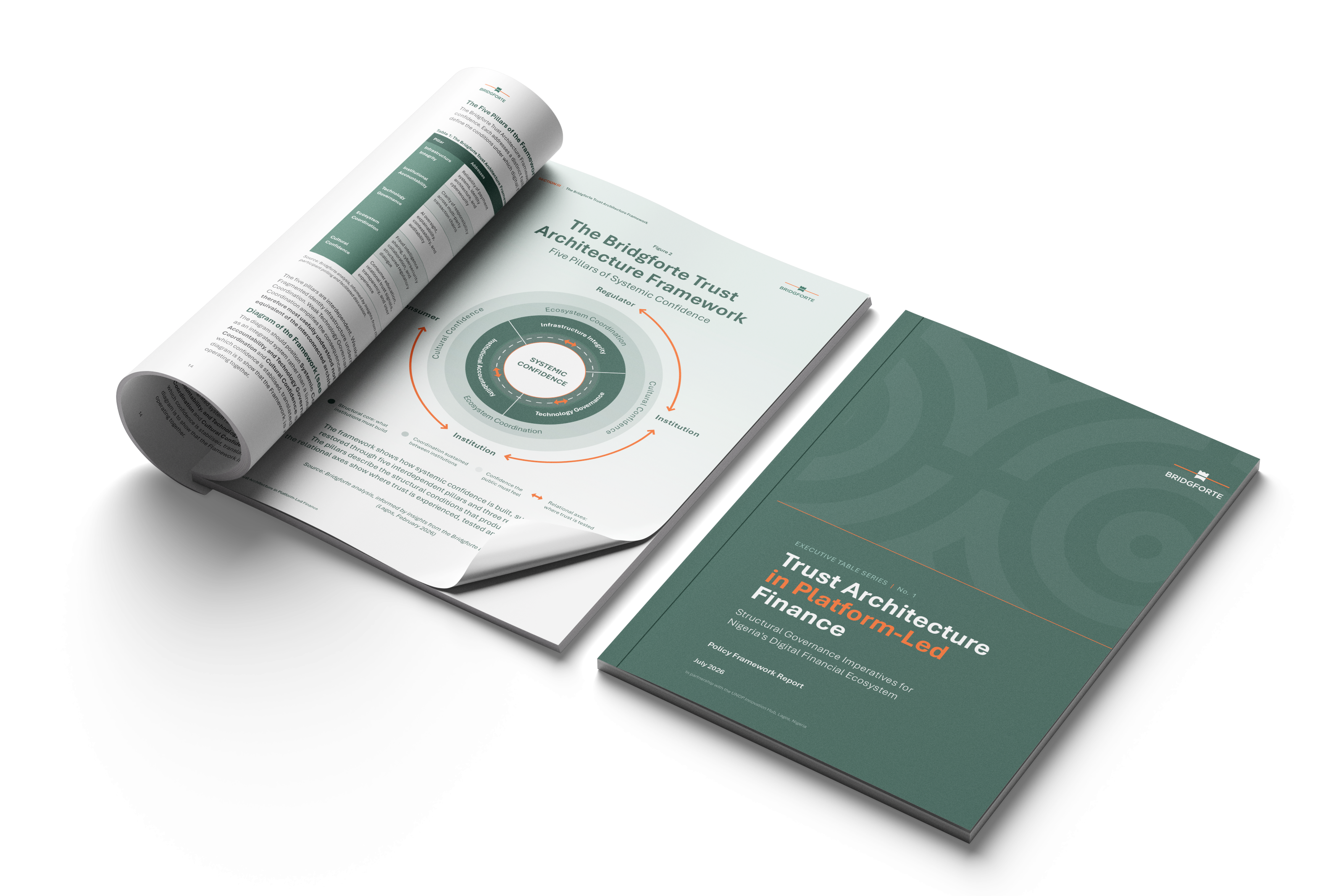
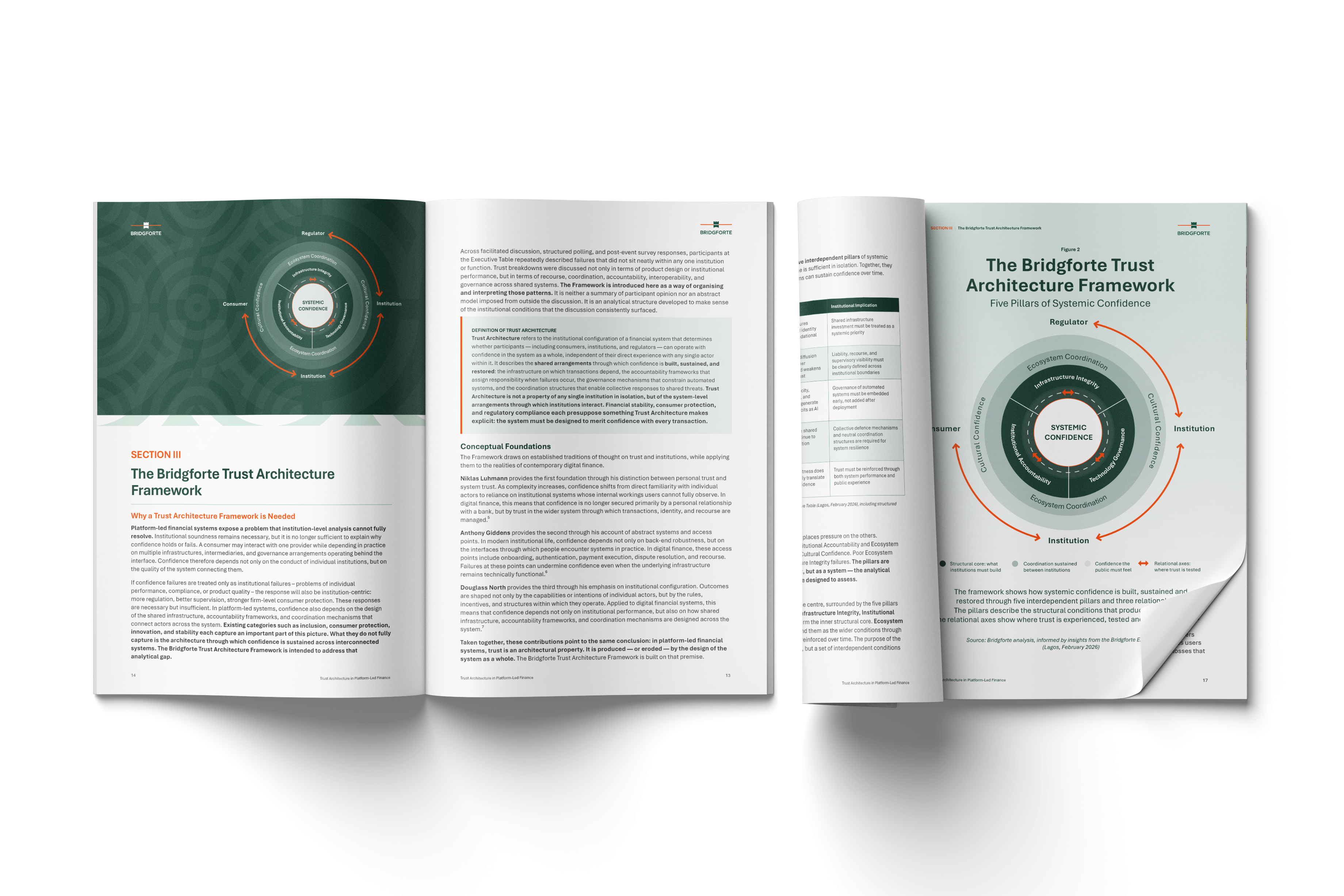
The Bridgforte Centre for Global Impact Trust Architecture Framework
Five interdependent pillars explain how confidence in digital financial systems is shaped not only by the performance of individual institutions, but by the infrastructure, governance, and coordination arrangements that connect them.
The framework operates across three relational axes:
Reliable rails: payments, identity, and the shared systems every transaction depends on.
Clear recourse and responsibility when transactions cross institutional boundaries.
Explainable, contestable, well-governed AI and data practices.
Shared fraud intelligence, cybersecurity, and consumer-protection capabilities.
The lived trust that turns access into sustained, active participation.
Recommendations
Ten recommendations, three audiences
A shift from institution-level optimisation to system-level design: from governing individual actors to designing the architecture that connects them.
Regulators & government
agencies
01Mandate interoperable identity infrastructure as shared public investment.
02Establish mandatory fraud-intelligence sharing with binding participation.
03Publish binding AI governance standards, including explainability and contestability.
04Commit to a phased transition toward outcome-based supervision.
Financial
institutions
05Treat dispute resolution as a strategic investment, not a cost centre.
06Adopt AI governance frameworks ahead of regulatory mandates.
07Lead in building the cross-sector collaboration infrastructure the system lacks.
Development partners & research institutions
08Commission a longitudinal Trust Barometer for Nigeria's financial system.
09Support shared AI training datasets relevant to African financial systems.
10Facilitate cross-country learning that positions Nigeria as an exporter of governance frameworks.

Read the full framework, findings, and policy agenda
Eight structural implications, ten recommendations, and the complete Trust Architecture Framework, plus the polling data behind them.
Download available 28 July 2026Trust Architecture in Platform-Led Finance · 42 pages · June 2026
{{ shareNote }}
Get the report (PDF)
Tell us who you are and we’ll start your download.
{{ form.error }}
{{ form.note }}
Thank you, {{ form.doneName }}!
Your download should start automatically. If it doesn’t, use the button below.
Download the report (PDF)